
What is water? Water is the most abundant substance on our planet, in our body, and in our food: it makes up between 70 and 90% of organic matter. If you have the opportunity to speak to a nutritionist, they will confirm that the three main diseases that affect humans (heart disease, cancer and stroke) are caused mainly by poor nutrition. Of course, genetic factors predispose one to developing such diseases, but their degenerative process can be accelerated or reversed, mainly by our food choices. Obesity, hypertension, and type-II diabetes, too, which are at almost epidemic levels today, are determined mainly by individual nutrition. A chemist, on the other hand, would confirm that the make-up of food is quite simple: it mainly consists of just four types of atoms - carbon, nitrogen, oxygen and hydrogen - with some trace minerals. The majority is water. And this closes the circle of the fundamental function it carries out.
Water and sport
The recommended daily intake is 2 litres (equivalent to 8 glasses), and better if spaced apart from meals, which is also useful advice for appetite regulation. But it’s even better to drink if you’re not feeling thirsty because, by the time you do feel thirsty, this is already a symptom of dehydration. And what about those who do sport? On average, during physical activity, you can lose around 500 ml of liquid every hour and, in some cases, up to 2 litres/hour. It is therefore important to start physical activity already well hydrated, in order to maintain the water balance, i.e. the relationship between the intake and loss of fluid.
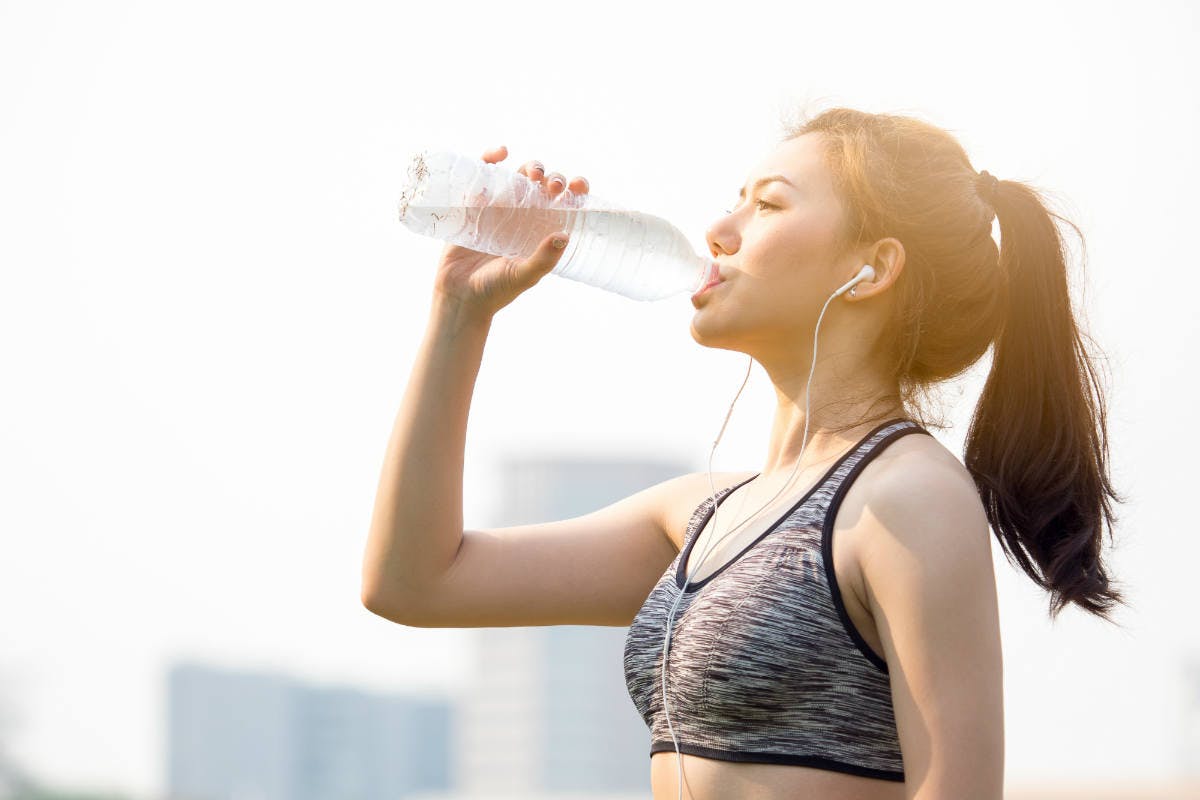
In more detail, the rate of loss depends on parameters such as the intensity of the activity performed, whether sport is played indoors (for example basketball or volleyball), its duration, the weather conditions(especially if hot and humid), the athlete’s constitution (gender, age, weight, general physical condition), and their gear(including the perspiration capacity). All these elements together contribute to increasing the body temperature, which is then regulated by thermoregulation mechanisms (perspiration and evaporation).
A lack of water is not well-tolerated by the body, resulting in an impairment of sporting performance: a loss of 2% of the total volume of water in the body will alter the thermoregulation and negatively influence the efficiency and the physical capacity of the subject, while a loss of 5% results in a risk of cramps and can cause a reduction in sporting performance of approx. 30%. If the water loss rises above 5%, the homoeostasis of the body is compromised, and this may seriously compromise human health, due to the risk of hypothermia or heat stroke.