
We continue to believe strongly that health and wellness is not just a fad and will continue to be an important trend in consumers' minds globally. Although we have heard of better-for-you snacks, no sugar colas, natural toothpaste, pure diapers, unbleached paper towels, etc., most consumers don't spend an enormous amount of time on what makes up 60% of our bodies—water. We believe water is the next focus of consumer health-and-wellness. As part of our Consumer Weekend Blast, we interviewed the cofounder of Hallstein Water, "the world's best water", (and admitted water nerd) Alex Muhr. We hope you enjoy this discussion below (for full disclosure, we've received samples of water from Hallstein...and we love it! Also, responses edited for clarity).
When did you start caring about water so much?
I really started caring about water because of my parents. Back in 1999 around the dinner table, after they learned about how seriously bad drinking juices and sodas are, they told us we had to stop and only drink water instead. As a thirteen-year old you normally don’t want to follow direction so my younger siblings and I had the rebuttal – "why?" If you know my parents, they always want really specific answers backed with a legitimate reason. After sort of just telling us to listen, they jointly realized that, in fact, they did not really know much about water and they said, "we’re going to find the best water" so there is no excuse from us children to have any reason not to drink it. My siblings and I naturally also took an interest that became more intense as the project developed.
My parents began by calling who they thought were experts to tell them which water to buy with scientific reasons. Something that is truly good for you to drink. Those answers were not sufficient for them, especially because how devoid of information water labeling was. Over the next few years, it became a family project, where my parents were learning more and more about drinking water quality by reading up themselves and discussing the parameters with experts. Then we’d discuss those findings as a family—slowly building up our knowledge base and interest in drinking water quality - finding the best for the family.
Why do you care so much about water?
I care about water because it is at the same time probably the most important element of nature, while also being one of the most underappreciated, undervalued, and little understood elements in the world. Leonardo da Vinci once wrote "Water is the driving force in nature." What would the world be without water? What would humanity be without water? What would life itself be without water? There are so many things to think about. Yet it seems that these days, at least in the Western world, it’s one of the most popular topics to pontificate on, and yet so easily taken for granted and misunderstood.
In the rest of the world, there are more than 700 million people who lack easy access to even rudimentary potable drinking water. This holds back the development of those areas drastically. Just think of the hours of productivity lost per day, not to mention the detrimental health effects of waterborne diseases. This is why as part of our company’s mission we want to help organizations that directly have an effect on improving water delivery systems in the third world. Two prime examples are packH2O and Operation Water, which we currently support.
What analytically makes a good water? How did you find that/what proof do you have?
That’s not an easy question to answer; there are no sound-bites here. It’s not possible to say that just on one parameter alone one water is better than another. You have to look at many different parameters together, and after looking at a lot of them, we were able to distill them down to the core metrics that we call the Hallstein Octagon.
Let’s begin with pH1 . At its core, the idea of consuming something alkaline, with a high pH, is to avoid inflammation. We began looking at what the easiest way would be for the family to begin avoiding inflammation, which is oftentimes caused by consuming excessive amounts of carbonated soft drinks, which are high in sugar. These days pH is misunderstood marketing jargon. While the idea of an alkaline diet is generally a good one, just drinking a water with a high pH does not magically cure ills or negate an acidic diet. At the same time, since your blood’s neutral pH is between 7.35-7.45 on the scale you’re not able to negate anything even if you tried with something below that. Since there is research to support that a higher pH water can be beneficial in avoiding inflammation in the body we added it to the list. Because the pH scale is logarithmic, you also don’t want something too high that could also cause harm, sp we decided to search for a water that had results between 8-9.5.
As a second parameter, we need to look at sodium. This is mainly because a water’s pH can be highly influenced by its mineral (aka electrolyte) content, including sodium, as well as calcium, magnesium, and others. Since we already consume sodium through foods, there would be no good reason to drink extra amounts, especially when they are excessive. Water companies have figured out that it’s very easy to boost the pH value by adding electrolytes, especially sodium, to water. Therefore, we wanted to look for a water that had very low amounts of sodium, ideally less than 1 mg/liter.
So really you want to look at pH and sodium in tandem.
Next, we researched a parameter called dissolved oxygen. At a basic level D.O. can signal a water’s purity. This cannot be achieved by adding oxygen to water. When a water molecule is formed it has a maximum saturation level of D.O. at a given temperature. This decreases as it’s exposed to certain things like organic material, nitrates or minerality that oxidize these 1 For those too far removed from Chemistry 101, we remind readers that pH is a scale of acidity from 0 (acidic) to 14 (alkaline), with a pH of 7 indicating a neutral substance. additional oxygen molecules out of the water. D.O. can only be measured at the source and is something that most water companies do not report at all. The positive effect of having a higher level in a water is that it can enhance the taste of consuming food and drink - giving a feeling of freshness. This is also due to the next parameters, in combination. Some research also suggests that higher D.O. can lead to improved recovery times after physical exertion. Our goal was to find a water with D.O. at the source that’s greater than 10 mg/liter.
Nitrates are generally very bad for your health to consume, although the EPA & FDA have extremely generous limits at 10 mg/liter. This is even after filtration and treatment techniques are applied! We decided to look for a water that would come in at less than 3 mg/liter directly at the source.
Similar to nitrates and D.O., the level of total organic carbon can be seen as a signal of natural purity of a water. The higher the level, the increased risk that bacteria are able to form in a water. We found that T.O.C. levels in drinking water should be at most 0.15 mg/liter naturally to reduce the risk of contamination. As a comparison, many municipal water sources target a T.O.C. level of below 2 mg/liter - after filtration and treatment.
We looked for something high in D.O. but very low in naturally occurring nitrates, and extremely low in T.O.C.—something that water experts are truly astounded by.
Total dissolved solids (T.D.S.) is generally a required parameter that companies need to disclose on a bottle label. Put simply, when you evaporate an amount of water at 180 deg C you’re left with a certain amount of minerals. This is measured to get the overall T.D.S. measured in mg/liter of water. You don’t want it to be too low (distilled water is technically zero T.D.S., something you want to put in your iron or clean microchips with) because that will, over a short period, begin to pull minerality from your body. When T.D.S. is too high, you begin depositing minerals in your body. So you’re looking for a happy medium, which is why we searched for a water that would fall between 50-250 mg/liter.
When you look deeper at T.D.S., you encounter electrolytes calcium and magnesium. What’s interesting is that your body can best absorb calcium when it’s in a 2 to 1 ratio with magnesium measured in mg/liter. Waters that purport to have added calcium are often even at 10:1 ratios or more, completely useless to your body. So we searched for a water with this 2:1 ratio.
Lastly, we looked at exit temperature to determine a water’s potential for contamination. This is another parameter that many water brands do not disclose. When a water exits the ground above 7 deg C (some even come out almost boiling!)—the likelihood that it’s not only chock-full of minerals but also harbors bacteria already is almost guaranteed. This is obviously something you don’t want, so we decided to look for water that exits consistently below 7 deg C / 45 deg F. This is sometimes called "glacial" water.
The following are brief, but no less important secondary parameters:
- Deep well: In looking for a well or source that is deeper than 100 meters, you are trying to find a water that has a lower likelihood of being contaminated. Whether by bacteria or by man-made contaminants from industry or agriculture. This isn’t to say a deep well can't have those harmful components, because deep wells also need other geological protective formations, but it’s a good indicator.
- Filled cold: Many water companies will heat up water to be able to fill bottles more securely and with less contamination risk in the filling process. We wanted to be able to fill our water aseptically, which means cold. This is much more expensive to do.
- No pumping: What you’re looking for is a water that comes from a truly artesian source that does not require additional pumping from the well or spring source, due to geologic considerations. Pumping, especially when it’s excessive or required, has the high likelihood of changing the water quality over time, which is an unacceptable risk for us.
- No Treatment and/or Filtration: The need for filtration techniques or chemical treatment necessarily indicates that the water is unsuitable for drinking naturally. This is not something we want to put in our bodies.
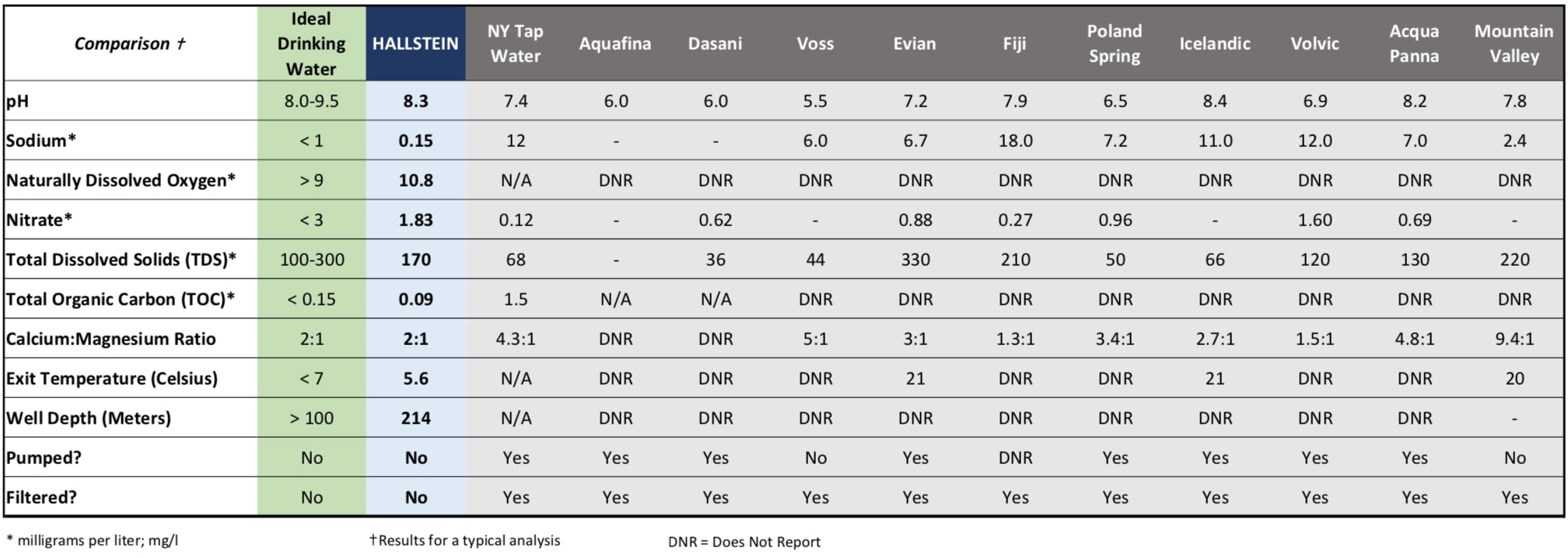
The results after defining the quality parameters and searching globally with multiple geological teams: A typical quality report shows that Hallstein comes in at a pH of 8.3, 0.15 mg/l of Sodium, 10.8 mg/l of D.O., 1.83 mg/l of Total Nitrates, 0.09 mg/l of TOC, 84 mg/l of TDS, a 2:1 Ca:Mg Ratio, and 5.6 deg Celsius. The secondary parameters include that Hallstein comes from a well depth of over 214m/700ft deep, is filled cold, and is not pumped, treated or filtered.
Is there really a difference in waters out there?
Many people say "water is water" or "water is just H2O". They are woefully misinformed. In our database (Exhibit 1) you can see how drastically different waters actually are on many different parameter levels. Two water sources just miles apart may have completely different pH, sodium levels, TOC amounts, exit temperatures, potential contaminants, etc. All this affects how the water could potentially be bottled, how it may need to be filtered, treated and so forth, which in the end can have an impact on the human body.
How do some popular waters test along those metrics?
You've tested many hundreds of waters. Can you share some of that data with our readers? The fact is that most, if not all waters are what some might call a "chemical cocktail". This really means that they are mechanically or chemically treated and often times both are applied. See Exhibit 1 for a comparison of key metrics.
EXHIBIT 1: Hallstein's water comparison vs. other U.S. waters